
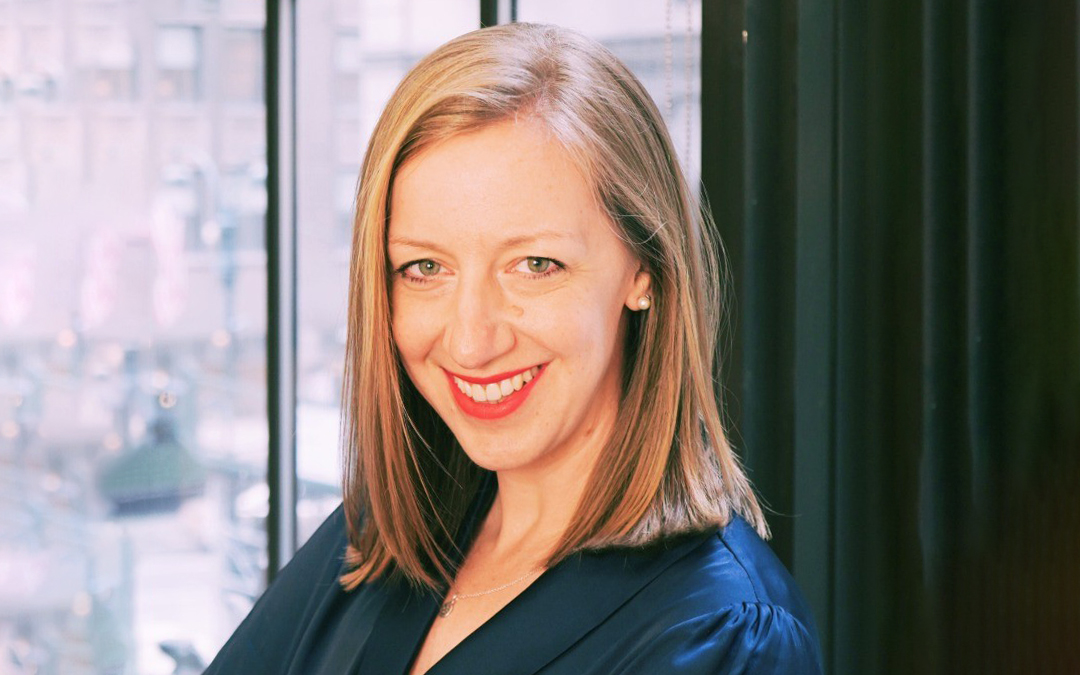
In the spotlight, this month is Sonja Kelly who is a Director of Research and Advocacy at Women’s World Banking. She holds a PhD in International Relations from American University and has over 10 years of experience in Research and Advocacy for Women’s Inclusion. She was also one of the first students in the cohort of the AI/machine learning course at Digital Frontiers Institute. She has used her experience to research and implement more inclusive financial services.
Tell us a bit about yourself and your career to date
My career has been firmly focused on financial inclusion advocacy and research, starting with an entry-level role in a global microfinance association, continuing with research and policy for financial inclusion with the World Bank, the Center for Financial Inclusion at Accion, and the U.S. Department of State. Now I get to leverage what I have learned along the way to lead a group of nine researchers, from interns to managers, who conduct research on women’s financial inclusion and economic empowerment all over the world on behalf of Women’s World Banking. It is a dream job getting to combine this diversity of experience in one role.
How did you come to work in digital financial services?
My focus on digital evolved naturally as the industry developed, but I focused on it exclusively when I was an advisor on digital finance policy at the U.S. Department of State. That is when I started my coursework to become a Certified Digital Finance Professional through the Digital Frontiers Institute. I work on digital financial services now at Women’s World Banking as we research new credit scoring algorithms and their impact on women’s financial inclusion, consider women customers’ connectivity and personal technology access and build evidence for what works in digital financial capability-building.
What is it that motivates you to continue with the work you are doing?
Real-life impacts. When a Ukrainian woman refugee can open a bank account because of revised KYC directives so that she can purchase supplies to open a hair salon. When a pregnant person can go to a hospital to have their baby knowing their insurance will cover the cost. When a young artist can sell her handicrafts on an e-commerce platform, and not have to worry about the money-handling side of the business. Financial services work in the background so that people can live their lives. That is what motivates me—finance meeting people’s real-life needs.
Are there specific challenges you are tackling today that you would like to highlight to our community?
In our work on the discriminatory potential of new data analysis methods like credit scoring, we discovered that even the fairest institutions face biases in some way. My colleagues and I at Women’s World Banking are working on a simple scorecard that will allow an institution to diagnose, quantify, and easily address biases in its portfolio. I love distilling complex problems into simple and easy-to-solve solutions, and this is a notable example that could make a significant impact.
How did you come to know Digital Frontiers Institute, and what have you enjoyed most about your interactions with us?
When I was at the Center for Financial Inclusion, a group of us joined the Certificate in Digital Money course, which I found to be helpful (particularly the country deep-dives). As I progressed in my career, I hit a gap in my knowledge of the technical side of the underlying technology. An opportunity opened for me to pursue being a Certified Digital Finance Professional, and I jumped at the chance. In addition to the technical side, I got to learn from industry experts about policy, applying a gender lens, and other topics.
How has your journey with Digital Frontiers Institute impacted your career?
I was in the first cohort of the AI/machine learning course, and clearly, that set me off on a journey that I am still on. Working with Women’s World Banking to provide technical assistance to and scale up bias mitigation in financial services is rewarding. I have also sent many of my team at Women’s World Banking to take courses at DFI, so we have a baseline understanding of common topics. I recommend the courses to anyone wanting to go deeper in their journey or to get up-to-speed on where things are in the industry.
What are your hopes for the future, and what would you like to see happen in this lifetime?
First, I want to see universal financial access. I think we all do, and we are so close to that goal as an industry. Second and much more importantly, I want all people to have an equal ability to translate their access to finance into life improvements and economic empowerment. If we do not see that jump from access to value, what have we all been working toward for the last few decades?
(Article originally shared on Digital Frontiers Institute on 24 August 2022)