

When you work in digital financial inclusion, it’s easy to get swept up in the promise of a single, transformative piece of technology. We imagine a future where an app connects farmers directly to buyers, where satellite data automatically disburses loans, and where mobile money replaces cash overnight.
After an intensive course on digitising agriculture at Digital Frontiers Institute, my key takeaway was this: that the future is a mirage, and chasing it can do more harm than good. The most profound insights were not about the technology itself, but about the human and commercial systems it must serve. True progress lies not in disruption, but in a more nuanced, collaborative approach.
This journey, from understanding the smallholder to orchestrating entire value chains, revealed three fundamental shifts we must make to build solutions that are both scalable and inclusive.

Shift 1: From Disrupting Intermediaries to Digitising Ecosystems
The narrative of “cutting out the middleman” has been a persistent theme in agritech. The idea is seductive: connect farmers directly to consumers, and they will capture more value, but, in practice, this model has largely failed to scale.
Why? Because it misunderstands the critical role these midstream actors, the local traders, aggregators, and processors, actually play. They are not just profiteers; they are the flexible, adaptive logistics and financing network that makes the market work. They provide transportation, aggregate small volumes into truckloads, and often offer the only source of informal credit available. They are the “hidden middle” that matches fragmented supply with dispersed demand.
This is especially critical when we consider the smallholder spectrum. For example, a pre-commercial farmer like Adla in Tanzania, who sells her maize in an unorganised way, these traders are her primary link to the market. Disrupting them without a better alternative leaves her isolated. The real innovation lies not in their elimination, but in their transformation.
Consider the broker-agent model pioneered by platforms like TruTrade. Instead of removing the agent, the platform changes its incentives. The agent’s income is no longer based on buying low and selling high, but on a commission tied to the final price the farmer receives. This aligns the agent’s success with the farmer’s prosperity. Crucially, the platform provides the capital, freeing the agent from cash-flow constraints and allowing them to focus on service and quality.
This is the first shift: stop building tools that dismantle the value chain and start building tools that make every actor within it more efficient, transparent, and aligned.
Shift 2: From a ‘Tech-First’ to a ‘Tech-and-Touch’ Model
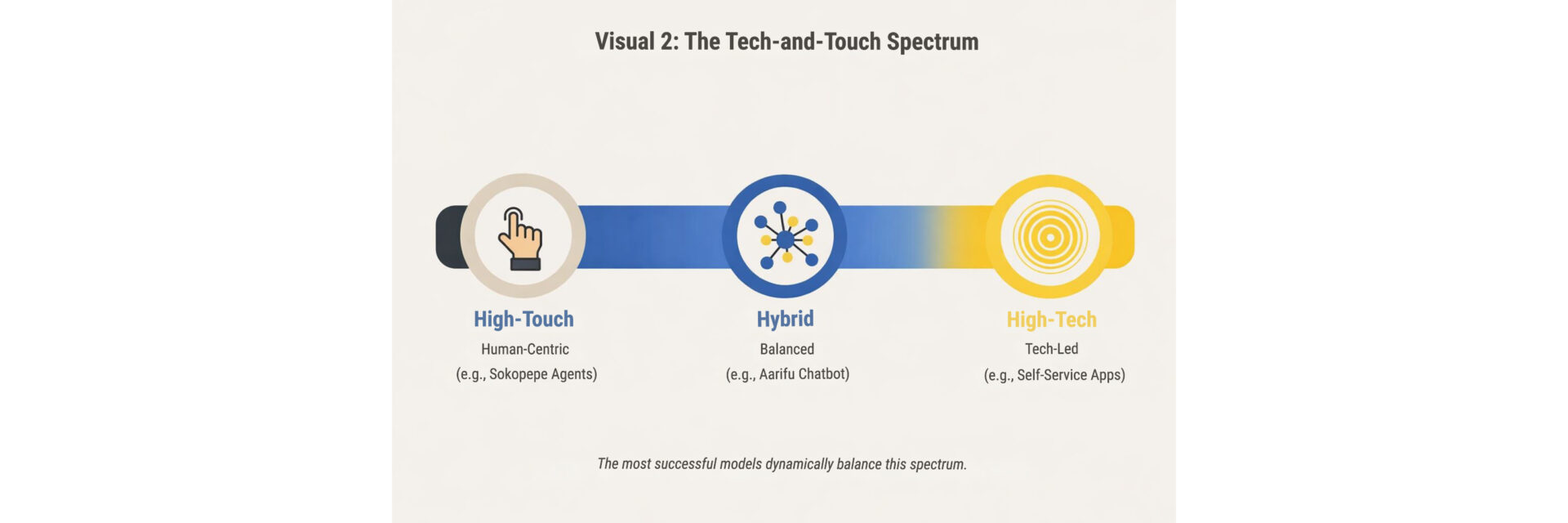
In our quest for scale, we often see human interaction as a cost to be engineered away. We dream of fully automated, self-service platforms. But in rural agriculture, where trust is the primary currency and digital literacy is often low, the human element is not the bottleneck; it is the bridge.
The most effective models strategically blend digital channels with human support. This “tech-and-touch” spectrum can be broken down simply:
- Tech enabling touch: Providing field agents with tablets to onboard farmers and process data in real-time.
- Tech imitating touch: Using call centres or WhatsApp groups to offer support and answer questions at a lower cost than pure face-to-face interaction.
- Tech replacing touch: A fully digital, self-service experience, which is only suitable for the most digitally savvy and trusting customers.
We see this balance in action across the ecosystem. Sokopepe Ltd, a social enterprise in Kenya, uses “Production Information Agents” to visit farmers and help them digitise their paper-based farm records. The agent provides the trust and training; the platform creates a valuable financial history. Similarly, Aarifu’s SMS-based chatbot delivers agronomic training, but its real potential lies in the data it collects on farmer engagement—data that can only be interpreted reliably because of the initial human-centred design used to create the content.
This principle also reframes the business case for services like savings because a standalone digital savings product is difficult to monetise. However, a product like myAgro’s layaway plan, which uses scratch cards and field agents (the “touch”) to help farmers save for inputs, acts as a powerful bridge. It builds a relationship and a transaction history, creating a foundation for cross-selling more profitable services like credit and insurance down the line.
The second shift, then, is to see human networks not as a barrier to scale, but as the scalable infrastructure for trust.
Shift 3: From Leading with Payments to Leading with Value
Mobile money is a revolutionary tool, but its adoption in agricultural value chains has been slower than many predicted. The reason is an asymmetric value proposition. For an agribusiness, digitizing payments saves significant costs in security, transport, and staff time. For a smallholder farmer, however, the benefits are often outweighed by the drawbacks: withdrawal fees eat into thin margins, and unreliable agent networks make cashing out a hassle. Cash, for all its risks, is frictionless and fee-free.
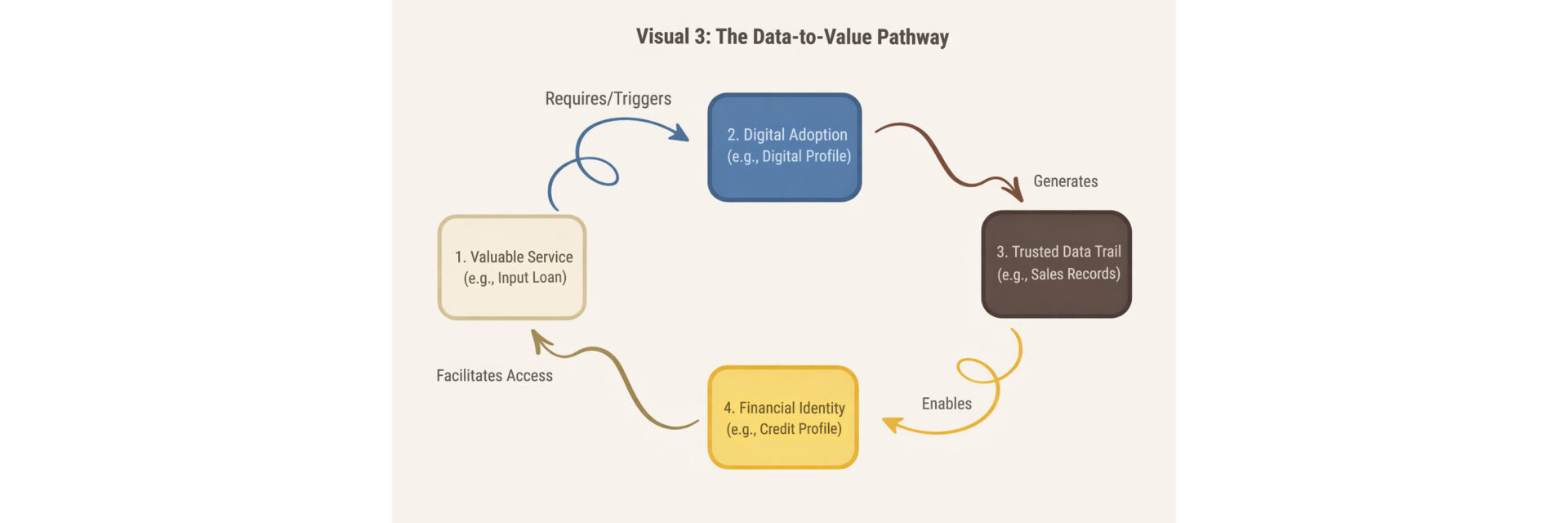
Trying to sell digital payments directly to farmers is an uphill battle. The successful strategy is to lead with a valuable service the farmer actively wants and make a digital wallet the key that unlocks it. Instead of saying, “Use mobile money to get paid,” the approach is, “To access this input loan (or this insurance product, or this premium buyer), you need a mobile wallet.” The digital payment becomes a requirement for a greater benefit, not the benefit itself. This creates a powerful “carrot” that naturally drives adoption.
Furthermore, this strategy creates a virtuous cycle that builds the third bridge: connecting farms to finance. As farmers transact digitally within the value chain, they leave a data trail. This data, of input purchases, sales volumes, and repayment history, becomes the raw material for building a financial identity.
For Example, a farmer like Adla might have no collateral, but her history of repaying an input loan from her supplier and her digital record of crop sales through a platform like Digiagri become her credit profile. This is how we begin to close the 200 billion USD smallholder financing gap —not by finding new capital, but by seeing the financial identity that was always there, embedded in the value chain.
The third shift is this: stop viewing data as the primary product. See it as a byproduct of a well-designed, value-first service that paves a pathway to full financial inclusion.

Final Thoughts: The New Role of an Innovator
The work of digitising agriculture is not for the lone wolf or the disruptive genius. It is for the ecosystem builder, the partnership orchestrator, and the patient architect and it requires us to build technology that serves people, not the other way around.
The most impactful organisations in this space will be those that master the art of the three shifts: digitising ecosystems instead of disrupting them, blending tech-and-touch instead of replacing it, and creating pathways to value that make digital tools indispensable.
This path is more complex and less glamorous than promising a revolution, but it is the only one that leads to sustainable, equitable, and inclusive growth for the millions of smallholder families who feed the world.
References
- Digital Frontiers Institute. (n.d.). Digitising Agriculture – Certified Digital Finance Practitioner. Retrieved November 15, 2025, from https://cdfp.digitalfrontiersinstitute.org/course/digitising-agriculture/
- ISF Advisors. (2025, October 13). ISF Advisors Launches Global Report on $200B+ Smallholder Finance Gap. https://isfadvisors.co/global-report-smallholder-finance/
By Raqibatu Zukaneni
Analyst (Product Development, Operations and Technology) at Accion
Digital Frontiers Institute Alum
(Article originally shared on Digital Frontiers Institute on 3 February 2026)